Long Division Explained

Wednesday, June 30, 2010 0 comments

Long Division Method - Double Division Step-by-Step


"Teaching Double Division can help in teaching long division by reinforcing the principles of division and giving students success with a less frustrating alternative.


Double Division does not depend on memorizing the multiplication facts or estimating how many times one number goes into another. It may take 50% longer, but it is far less frustrating and probably easier to understand than Long Division.
 
MOTIVATION:
The value of teaching manual division is to give people a method they can actually use if they have to, and to teach about mathematics.
It could be argued that if students seldom use long division after leaving school then it might be better for them to have a simpler and more intuitive method at their disposal - one that is easier to remember and understand. Would someone ten years out of school have an easier time doing long division or Double Division? - I'm not sure, but Double Division seems simpler to me.
About teaching math, I'm not sure that long division teaches math very well. It helps teach people how to follow a long procedure and it gives some practice multiplying and subtracting. I'm not sure how many people understand what is happening when you bring down the next digit or understand why you have to add a zero to the answer when the "number after subtracting" is less than the divisor.
One problem I see with Double Division is that you have to do more subtraction. I personally find subtraction harder than multiplication. The other problem is that (not counting the trial and error) Double Division will usually have more steps.

WHAT'S THE DIFFERENCE?
1) In long division you guess which multiple to subtract, where as in Double Division you pick from four options. (Any multiple you pick works. You don't always have to pick the largest possible one; sometimes I pick the easiest one to subtract.)
2) In Double Division you write out the zeros so it's clear how big the numbers are.
3) In Double Division you write your answer on the right side where you have room to accumulate many parts of the answer. In long division you write the answer on the top and have to get each digit of the answer exactly right - because there is only room there to write one number.
Here is how I see it so far:
REASONS TO TEACH DIVISION:
- to teach mathematics
- a method to actually use in rare instances
- to prepare students for higher math
Double DIVISION ADVANTAGES:
- teaches how division works
- no trial and error: I don't know how many times 372 go into 2711.
- easier to do: Double, double, double, subtract the best ones, add up the answer.
- gives practice doubling numbers
Double DIVISION DISADVANTAGE:
- more subtraction
- more steps (see note below)
- requires more space on the paper
- incremental difficulty in going on to decimals ?may? be more
- may not lead as directly to polynomial division - arguable
IS Double DIVISION LONGER?
If we assume there is an equal chance of all ten digits being in the answer then on average there will be 1.5X as many "multiple and subtract" steps. For example a "7" in the answer requires 3 steps, and a zero in the answer requires no steps.
Also remember that the multiply part of the "multiply and subtract" steps is already done for you. So this part will be faster. Of course you have to pre-multiple the divisor three times in the beginning.
In the end I think it is longer, but not as much as you might think initially.


It's Easy!
Step 1 - Double, double, double.
Step 2 - Subtract off multiples.
Step 3 - Add up your answer." 
Adapted from http://www.doubledivision.org
Read the full story

Long Division with Remainders

 Long Division Method - Double Division Step-by-Step


How to do long division with a remainder?
 Double Division with 3 Digit Divisors 612416/983 - Method of Vietnamese Diagram: Double the Divisor 3 Times


How to do long division for kids?
Method of International Diagram: Double the Divisor 3 Times


How To Do Long Division?


Long Division with Remainders

When we are given a long division to do it will not always work out to a whole number.
Sometimes there will be numbers left over. These are known as remainders.
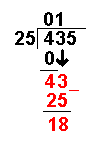
Taking an example similar to that on the Long Division page it becomes more clear:
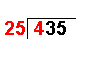
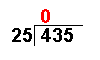
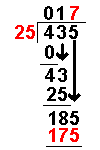
435 ÷ 25 

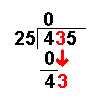
4 ÷ 25 = 0 remainder 4 The first number of the dividend is divided by the divisor.
The whole number result is placed at the top. Any remainders are ignored at this point.
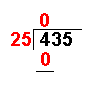
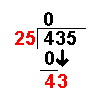
25 × 0 = 0 The answer from the first operation is multiplied by the divisor. The result is placed under the number divided into.
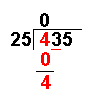
4 – 0 = 4 Now we take away the bottom number from the top number.
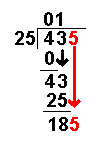
Bring down the next number of the dividend.
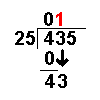
43 ÷ 25 = 1 remainder 18 Divide this number by the divisor.
The whole number result is placed at the top. Any remainders are ignored at this point.
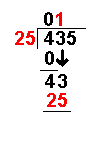
25 × 1 = 25 The answer from the above operation is multiplied by the divisor. The result is placed under the last number divided into.
43 – 25 = 18 Now we take away the bottom number from the top number.
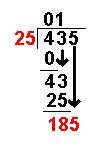
Bring down the next number of the dividend.
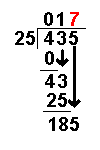
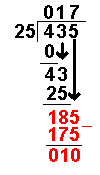
185 ÷ 25 = 7 remainder 10 Divide this number by the divisor.
The whole number result is placed at the top. Any remainders are ignored at this point.
25 × 7 = 175 The answer from the above operation is multiplied by the divisor. The result is placed under the number divided into.
185 – 175 = 10 Now we take away the bottom number from the top number.
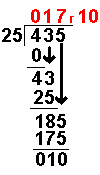
There is still 10 left over but no more numbers to bring down.
With a long division with remainders the answer is expressed as 17 remainder 10 as shown in the diagram


Read the full story

Addition and Subtraction Worksheets


Addition is bringing two or more numbers (or things) together to make a new total.


Here 1 ball is added
to 1 ball
to make 2 balls:
Using Numbers it is:    1 + 1 = 2
And in words it is: "One plus one equals two"

Example: If you add 2 and 3 you get 5. You would write it like this:
2 + 3 = 5


Try It

Write this down, with the answer, using numbers:

Swapping Places

Swapping the position of the numbers you are adding still gets the same result!
3 + 2 = 5 3+2=5
... also ...
2 + 3 = 5 2+3=5

More Examples:
5 + 1 = 1 + 5 = 6
7 + 11 = 11 + 7 = 18
4 + 100 = 100 + 4 = 104


4+3=? Read the full story

,

How to do long division for kids?

Tuesday, June 29, 2010 0 comments


How to do long division for kids?
How to divide a three digit number by a one digit number (e.g 413 ÷ 7).

  • Place the divisor before the division bracket and place the dividend (413) under it.
  • 
         
    7)413
  • Examine the first digit of the dividend(4). It is smaller than 7 so it can't be divided by 7 to produce a whole number. Next take the first two digits of the dividend (41) and determine how many 7's it contains. In this case 41 holds five sevens (5*7=35) but not six (6*7=42). Place the 5 above the division bracket.
  • 
       5 
    7)413
  • Multiply the 5 by 7 and place the result (35) below the 41 of the dividend.
  • 
       5 
    7)413
      35
  • Draw a line under the 35 and subtract it from 41 (41-35=6). Bring down the 3 from the 413 and place it to the right of the 6.
  • 
       5 
    7)413
      35
       63
  • Divide 63 by 7 and place that answer above the division bracket to the right of the five.
  • 
       59
    7)413
      35
       63
  • Multiply the 9 of the quotient by the divisor (7) to get 63 and place this below the 63 under the dividend. Subtract 63 from 63 to give an answer of 0. This indicates that there is nothing left over and 7 can be evenly divided into 413 to produce a quotient of 59.
  • 
       59
    7)413
      35
       63
       63
        0


 Toán Chia Lớp 3 - Lý thuyết phép chia: Phép chia: chia số có 3 chữ số cho số có 1 chữ số
Lưu ý: trong bài học này và các bài học tiếp theo, chúng ta sẽ học cách trình bàythực hiện các bước của phép chia số học theo thông lệ quốc tế. Bởi vậy có nhiều khác biệt so với cách trình bày và vị trí đặt số bị chia, số chia, dấu ký hiệu phép chia trong sách giáo khoa Việt Nam.

Cách để chia số có ba chữ số cho số có một chữ số (thí dụ 413 ÷ 7).
  • Đặt số chia (7) trước dấu ngoặc ôm của phép chia và đặt số bị chia (413) ở phía bên dưới dấu này.
  • 
         
    7)413
  • Khảo sát thấy rằng chữ số thứ nhất của số bị chia (số 4) nhỏ hơn 7 nên không thể chia cho 7 để được kết quả là một số nguyên. Nên ta lấy hai chữ số đầu của số bị chia (41) và xác định xem nó có thể chia hết cho bao nhiêu bộ số 7. Trong trường hợp này, 41 chứa đựng năm bộ số 7 (5*7=35) chứ không thể là sáu (6*7=42). Ta đặt số 5 ở dòng phía bên trên dấu ngoặc ôm của phép chia.
  • 
       5 
    7)413
  • Nhân 5 với 7 và đặt đáp số (35) xuống dòng phía bên dưới số 41 của số bị chia.
  • 
       5 
    7)413
      35
  • Kẻ một đường ngang dưới số 35 và lấy 41 trừ đi 35 ta được 6 (41-35=6). Hạ chữ số 3 từ số 413 xuống dòng phía bên dưới và đặt ở bên phải của 6.
  • 
       5 
    7)413
      35
       63
  • Chia 63 cho 7 và đặt đáp số lên dòng phía trên dấu ngoặc ôm của phép chia và nằm bên phải của số 5.
  • 
       59
    7)413
      35
       63
  • Nhân thương số (9) với số chia (7) được 63, ta đặt số 63 xuống dòng phía bên dưới số bị chia 63. Trừ 63 cho 63 cho ta đáp số là 0. Điều nay cho biết không còn gì từ phía bên trái và thương số (59) của phép chia 413 cho 7 là một số chẵn.
  • 
       59
    7)413
      35
       63
       63
        0

Tham khảo: cách để chia 413 cho 7 theo chuẩn được trình bày trong sách giáo khoa Việt Nam.

Chia theo thứ tự từ trái sang phải:
  • 41 chia cho 7 được 5, viết 5;
  • 5 nhân 7 bằng 35; 41 trừ 35 bằng 6, viết 6.
  • Hạ 3, được 63; 63 chia cho 7 được 9, viết 9;
  • 9 nhân 7 bằng 63, 63 trừ 63 bằng 0, viết 0.
  • Đáp số 413 chia cho 7 được 59.
  • 
    413   | 7
       |________
    63   |59
    63   |
    ___
    00
Read the full story

,

How To Do Long Division Step by Step?


How to do long division step by step?
How to do long division for kids?

Long Division: Dividing a 4-digit by 2-digit numbers
How to divide a four digit number by a two digit number (e.g. 4138 ÷ 17):

  • Place the divisor before the division bracket and place the dividend (4138) under it.
  • 
           
    17)4138
  • Examine the first digit of the dividend(4). It is smaller than 17 so can't be divided by 17 to produce a whole number. Next take the first two digits of the dividend (41) and determine how many 17's it contains. In this case 41 holds two seventeens (2*17=34) but not three (3*17=51). Place the 2 above the division bracket.
  • 
        2  
    17)4138
  • Multiply the 2 by 17 and place the result (34) below the 41 of the dividend.
  • 
        2 
    17)4138
       34
  • Draw a line under the 34 and subtract it from 41 (41-34=7). Bring down the 3 from the 4138 and place it to the right of the 7.
  • 
        2 
    17)4138
       34
        73
  • Divide 73 by 17 and place that answer above the division bracket and to the right of the two.
  • 
        24 
    17)4138
       34
        73
  • Multiply the 4 of the quotient by the divisor (17) to get 68 and place this below the 73 under the dividend. Subtract 68 from 73 to give an answer of 5. Bring down the 8 from the dividend 4138 and place it next to the 5
  • 
        24 
    17)4138
       34
        73
        68
         58
  • Divide 58 by 17 and place that answer (3) above the division bracket and to the right of the four.
  • 
        243
    17)4138
       34
        73
        68
         58
  • Multiply the 3 of the quotient by the divisor (17) to get 51 and place this below the 58 under the dividend. Subtract 51 from 58 to give an answer of 7.
  • 
        243
    17)4138
       34
        73
        68
         58
         51
          7
  • There are no more digits in the dividend to bring down so the 7 is a remainder. The final answer could be written in several ways.
    243 remainder 7 or sometimes 243r7
    or as a mixed number 243  7/17

Toán Chia Lớp 3 - Tính phép chia với thời gian kéo dài: Chia số có 4 chữ số cho số có 2 chữ số

Lưu ý: trong bài học này và các bài học tiếp theo, chúng ta sẽ học cách trình bàythực hiện các bước của phép chia số học theo thông lệ quốc tế. Bởi vậy có nhiều khác biệt so với cách trình bày và vị trí đặt số bị chia, số chia, dấu ký hiệu phép chia trong sách giáo khoa Việt Nam.

Cách để chia một số có bốn chữ số cho một số có hai chữ số (thí dụ. 4138 ÷ 17):
  • Đặt số chia (17) trước dấu ngoặc ôm của phép chia và đặt số bị chia (4138) ở phía bên dưới dấu này.
  • 
           
    17)4138
  • Khảo sát thấy rằng chữ số thứ nhất của số bị chia (số 4) nhỏ hơn 17 nên không thể chia cho 17 để được kết quả là một số nguyên. Nên ta lấy hai chữ số đầu của số bị chia (41) và xác định xem nó có thể chia hết cho bao nhiêu bộ số 17. Trong trường hợp này, 41 chứa đựng hai bộ số 17 (2*17=34) chứ không thể là ba (3*17=51). Ta đặt số 2 ở dòng phía bên trên dấu ngoặc ôm của phép chia.
  • 
        2  
    17)4138
  • Nhân 2 với 17 và đặt đáp số (34) xuống dòng phía bên dưới số 41 của số bị chia.
  • 
        2 
    17)4138
       34
  • Kẻ một đường ngang dưới số 34 và lấy 41 trừ đi 34 (41-34=7). Hạ chữ số 3 từ số 4138 xuống dòng phía bên dưới và đặt ở bên phải của 7.
  • 
        2 
    17)4138
       34
        73
  • Chia 73 cho 17 và đặt đáp số (4) lên dòng phía trên dấu ngoặc ôm của phép chia và nằm bên phải của số 2.
  • 
        24 
    17)4138
       34
        73
  • Nhân thương số (4) với số chia (17) được 68, ta đặt số 68 xuống dòng phía bên dưới số bị chia 73. Trừ bớt đi 68 từ 73 cho ta đáp số là 5. Hạ chữ số 8 từ số bị chia 4138 xuống dòng phía bên dưới và đặt ngay sau số 5 (đặt bên phải số 5)
  • 
        24 
    17)4138
       34
        73
        68
         58
  • Chia 58 cho 17 và đặt đáp số (3) lên dòng phía trên dấu ngoặc ôm và nằm bên phải của số 4.
  • 
        243
    17)4138
       34
        73
        68
         58
  • Nhân thương số (3) với số chia (17) cho 51, đặt 51 xuống dòng phía bên dưới số bị chia 58. Trừ đi 51 từ 58 cho đáp số là 7.
  • 
        243
    17)4138
       34
        73
        68
         58
         51
          7
  • Nhận thấy không còn chữ số nào trong số bị chia để có thể hạ xuống để thực hiện tiếp phép chia, nên 7 là số dư. Đáp số cuối cùng có thể được viết bằng một vài cách sau.
    243 dư 7 hoặc đôi khi ta viết 243d7
    hoặc viết ở dạng hỗn số 243  7/17
Read the full story

,

Adding Fractions with Different Denominators

Addition Fractions - Unlike Denominators


How to Add Fractions with different denominators:
  • Find the Least Common Denominator (LCD) of the fractions
  • Rename the fractions to have the LCD
  • Add the numerators of the fractions
  • Simplify the Fraction


Example: Find the Sum of 2/9 and 3/12
  • Determine the Greatest Common Factor of 9 and 12 which is 3
  • Either multiply the denominators and divide by the GCF (9*12=108, 108/3=36)
  • OR - Divide one of the denominators by the GCF and multiply the answer by the other denominator (9/3=3, 3*12=36)
  • Rename the fractions to use the Least Common Denominator(2/9=8/36, 3/12=9/36)
  • The result is 8/36 + 9/36
  • Add the numerators and put the sum over the LCD = 17/36
  • Simplify the fraction if possible. In this case it is not possible
Read the full story

Free Download Babylon Professional 8.0.6

Babylon Professional 8.0.6 (r3) Final - Multilangual Full 8.9 MB


Babylon Pro 8 is the ultimate all-in-one translation solution operated by a single click on your mouse. Simply click on a word or text in any desktop application and get instant translation results into 75 languages. Translation of full texts, Web pages and comprehensive documents is supported by 31 languages. All these features and more, like the integration into Microsoft Office Speller menu, contextual access, language detection, currencies and units conversion, are accessible without interrupting your work flow. Babylon 8 comes with a new dictionary pack, including updated Babylon dictionaries and 17 new Wikipedia titles. You may enhance your translation experience with premium content dictionaries from acclaimed publishing houses such as Oxford, Britannica, Merriam-Webster, Larousse, Vox, Langenscheidt, Pons, and Duden. With Babylon 8, understanding, reading and writing in all languages is easier, faster, and more efficient than ever before.

Version 8.0 r20 features translation of full Web pages and documents, seamless integration into Microsoft Office Speller, easier access and new dictionaries.

Babylon Pro 8 features:
• Single Click activation
• Text translation - in 31 languages
• Results from the world's leading publishers
• Encyclopedias including Wikipedia content
• Translations in more than 75 languages
• Unit Conversions - Convert currencies, measurements and time
• Writing Tools for English
• Spelling Alternatives
• Technical Requirement

• Single Click Activation
Babylon online dictionary is a simple and intuitive tool operated by a single click. Just click on any text written in Word, Excel, PowerPoint, emails, web pages, instant messages or any other desktop application. A small window will instantly appear containing the translation results, as well as any information or conversion that you require. You can also easily copy/paste to and from Babylon. Actually, once installed in your computer, Babylon will become a powerful and innovative reference tool of easy use that will allow you immediate online access to dictionaries and encyclopedias covering all topics and themes.

• Text Translation
Text translations in 31 languages, all in a single click. Text translation has never been easier; no need for additional browsers or copy/paste. Just click any word in the text you want to translate and Babylon will automatically identify the inserted text passage and translate it. Despite the fact, that no machine translation is 100% accurate or delivers results equal to human translation, this great new feature, based on the most advanced text translation technology, helps you understand texts in languages you are less familiar with.

Babylon's text translation is available in the following languages: English, French, German, Spanish, Italian, Portuguese, Japanese, Hebrew, Chinese (Traditional), Chinese (Simplified), Dutch, Russian, Korean, Turkish, Arabic, Farsi, Polish and Ukrainian.

• Results from the world's leading publishers
Get single click results from the world's leading dictionaries and encyclopedias for a small additional fee. Babylon offers its users a wide range of titles from the world's premier publishing houses: Britannica, Oxford, Merriam Webster, Pons, Larousse, Langenscheidt, Taishukan, Michaelis, Van-Dale and many more. View a list of all the dictionaries and encyclopedias that Babylon offers.

• Wikipedia content
Babylon online dictionary's single click intuitive technology now offers its users results from Wikipedia, The Web Free Encyclopedia, a multilingual web-based encyclopedia in 13 languages covering more than 2.2 million articles and definitions that are constantly updated according to the current events and science latest innovations. The combined use of online applications such as Babylon and Wikipedia, are today imperative tools for pupils, students and professional translators.

• Translation in more than 75 languages
Babylon's translation and dictionary software offers results from a database of 1,300 sources in more than 75 languages. The database includes 25 professional dictionaries in 31 languages developed by Babylon's own linguistic team: English, French, German, Spanish, Italian, Portuguese, Japanese, Hebrew, Chinese (Traditional), Chinese (Simplified), Dutch, Russian, Korean and Swedish. In fact, Babylon has developed a unique instant computerized translation tool that will eventually replace your traditional printed dictionaries, offering an immediate and online access to Internet information sources and a wide range of online dictionaries and glossaries that are constantly updated.

• Units & Measures Conversion
Babylon converts currencies, measurements and time-units, just click on any value in any desktop application to get instant conversions. Babylon online dictionary will automatically identify the required conversion type, based on unit symbols that appear next to the numbers. There is no more need to contact the bank or surf the web, an advanced conversion technology will allow you to find out online, at a single click, actual timetables and currency values, which are automatically updated on a daily basis.

• Writing Tools for English
In addition to text translation, Babylon online dictionary also offers its users tools for finding the exact word they are looking for and guarantee a correct verbal conjugation. Given that many words may be translated in several ways, Babylon enables its users to see each possible translation with its equivalent translation, in the user's native language. Babylon also shows all possible conjugations, enabling thus the correct usage of the term.

• Spelling Alternatives
An automatic spelling feature available in Babylon provides solutions for common typos, misspellings and wording problems.

Multilingual: English, Spanish French, Italian, Japanese, Portugués, German, etc
Compatible with: Windows XP, Vista and Windows 7.


Download: 
  • http://rapidshare.com/files/358324672/Babylon_8.0.6_r3.rar
  • http://www.mediafire.com/?yzklyyvmnwm
  • http://www.mediafire.com/download.php?zm5lfgjlg4b (password:softvnn.com)
Read the full story

, , ,

Kids Math Lessons

Monday, June 28, 2010 0 comments


Kids Math Lessons, Kids Math Games, Kids Math Practice, Kids Math Worksheets
Read the full story

Why Study Math?

Monday, May 31, 2010 0 comments


Why Study Math?
Math is often referred to as a universal language. Discover reasons for studying math with tips from a mathematics tutor in this free video on math lessons.

Expert: Fernando Millan
Filmmaker: Paul Muller


Read the full story

,

Mathematic Skills for Grades 3-6


NUMBER OPERATIONS AND CONCEPTS
  1. A+ Math  Play exciting games like Matho and Hidden Picture (+ -x /)  Also has great flashcards
  2. Builder Ted In this interactive game, students must order decimals
  3. Comparing Big Numbers
  4. Comparing fractions and decimals - Practice converting one to the other in this interactive game.


  5. Concentration Games from Harcourt Brace: Fractions/Decimal Equivalents, Fractions/Decimal Equivalents II, Fractions/Decimal Equivalents III, Equivalent fractions, Decimals, and Percents.
  6. Cash Out You're the cashier at this crazy store. You need to give change to the customers buying things. Try to sell as many items as possible before the time runs out.
  7. Change Maker Get as much money in your piggy bank as possible, by figuring out the correct change. From FunBrain
  8. Count the Goodies - This multiplication activity from Harcourt School’s Mighty Math Calculating Crew asks you to multiply using regrouping. Three problems at a time are presented.
  9. Decimal Squares Add, subtract and multiply decimals in a multitude of games. New!
  10. Divisibility Rules Simplify your math!
  11. Division Machine This activity has three levels of division for students to practice. New!
  12. Disaster Math - Six sets of interactive word problems: Earthquake Math, Hurricane Math, Tornado Math, Wild Fire Math, Winter Storm Math, and Flood Math.
  13. Fraction Shapes Explore geometric models of fractions and discover relations among them.
  14. Fractions, Decimals or Percent - two are given, you supply the third
  15. Fresh Baked Fractions Click on the fraction that is not equal to the others. From FunBrain. Easy to Super Brain
  16. Game Bone Can you find the 10 hidden bones on the 1 - 100 number square in less than a minute ? (Grade 3)
  17. Genius Boxing Punch your genius opponent by completing the number sentence using <, >, or =. (Grade 3) New!
  18. Guess the Number Developing skills in halving and estimation
  19. Interactive Activities Number and Operations
  20. I Know That!  Online Multimedia Fraction Games, Registration is free!
  21. Hooda Math Hooda Math is all about making math fun and making math easy. Teacher and Student Recommended
  22. Johnnie's Math Page Multiplication Activities
  23. Magic Math Market Discover the magic of two important mathematical concepts: fractions and decimals. (Grades 3-5)
  24. Math 5 Live Lessons> Place Value, Multiples, Factors, Primes, Fractions, Decimals, Multiplication and Division (Grade 5)
  25. Math Baseball Math practice from FunBrain (+ - x /)
  26. Math Run How fast is your brain? A simple brain training game for everyone. Begins with simple addition facts and gets progressively more difficult. New!
  27. Maths: Fractions - Revisewise-Interactive guide to fractions
  28. Maths: Number Patterns - Revisewise-Interactive guide to patterns
  29. Multiplying Fractions Practice multiplying fractions. (Grades 4-6)
  30. Number Cop Choose your game mode: select a number to practice multiples of that number, or select 'Primes' or 'Perfect Squares'. In each game type you will have a total of 50 numbers to test.
  31. National Library of Virtual Manipulatives Number & Operations (Grades 3-5)
  32. National Library of Virtual Manipulatives Number & Operations (Grades 6-8)
  33. One False Move Step into the wrong room and you'll be doomed. You are given a table of numbers.
    Click on the numbers in order from lowest to highest (or highest to lowest). (Easy-Medium-Hard)
  34. Penguin Waiter Game Figure out the tip from FunBrain
  35. Percent Problems - a one-player, or two-player Jeopardy style game from Quia
  36. Place Value Darts Use known number facts and place value to multiply and divide integers, including by 10 and then 100 (whole- number answers). (Grades 5-6)
  37. The Place Value Game -A math game requiring logic, strategy and a little luck!
  38. Place Value Puzzler Choose Place Value. Easy · Medium · Hard · Super Brain.
  39. Place Value Up to 1000 Can you put your knowledge to the test to beat Robbie the Robot? (Grade 3)
  40. Power Football   All operations with decimals. From FunBrain
  41. QUIA Math Journey  An online math activity. (+ - x /,rounding)
  42. Rounding-Fun Brain gives games (Easy, Medium, Hard, Super Brain)
  43. Rounding Off Round off numbers to significant figures, decimal places or the nearest 10, 100 or 1000. From BBC
  44. Snork's Long Division Game A step by step long division game that allows students to practice their long division skills
  45. Soccer Shootout - Multiplying Fractions from FunBrain
  46. Solving Percent Problems Using a Pyramid Grid - an interactive lesson
  47. Spy Guys Interactive Lessons>Decimals, Percents, Integers, Prime Factorization, Fractions, Problem Solving Bank (Grade 6)
  48. Tic Tac Toe Squares Get three X's in a row before the computer gets three O's in a row. From FunBrain (+ - x /) Easy to Super Brain
  49. Visual Fractions This Fractions is a collection of activities that use pie charts, number lines, and other graphics to illustrate fraction operations.
  50. Wicked Interactive Play these exciting mathematic games to improve your basic fact recall
  51. www.multiplication.com Interactive games to help teach the multiplication facts.
MEASUREMENT
  1. Beat the Clock Interactive time game
  2. Gamequarium: Math Games-Measurement
  3. Math 5 Live - Lessons> Area, Perimeter, Volume (Grade 5)
  4. Measurement Equivalents - Match game with standard equivalent measurements, such as pounds, ounces, pints, cups, etc.
  5. Measurement Game - Practice using a ruler, in inches and centimeters. FunBrain
  6. National Library of Virtual Manipulatives Measurement Manipulatives (Grades 3-5)
  7. National Library of Virtual Manipulatives Measurement Manipulatives (Grades 6-8)
  8. Spy Guys Interactive - Lessons>Area, Perimeter, Volume
  9. What Time Will It Be?
ALGEBRA
  1. Algebra Planet Blaster - Practice your math and defend your planet!
  2. Angles - Interactive game to help recognize and label acute, obtuse, and right angles.
  3. Catch the Fly - [all 4 quadrants are used] Use the keyboard to enter the x and y values of an ordered pair to help the fly catch a bug. No score is kept, each question is essentially a one question game
  4. Cool Math - Pre Algebra has a ton of really easy to follow lessons and examples that will make you a successful pre-algebra student.active game
  5. Create your own pattern - Drag shapes to create a pattern. Instructions on how to use this page in your classroom.
  6. Elapsed Time on a Clock - From Harcourt School Publishers
  7. Gamequarium: Math Games-Algebra
  8. Interactive Activities Algebra
  9. Maths: Shapes - Revisewise-Recognize properties and names of shapes
  10. Measuring Angles - Use a virtual protractor for making measurements.
  11. Measuring Angles - Investigating angles and the use of a protractor
  12. National Library of Virtual Manipulatives Algebra Manipulatives (Grades 3-5)
  13. National Library of Virtual Manipulatives Algebra Manipulatives (Grades 6-8)
  14. Number Cracker - guess what number comes next in the pattern
  15. Spy Guys Interactive - Lessons>Summarizing and Extending Patterns
  16. What's the Point - Find the x-y point on the grid.  Funbrain
DATA ANALYSIS AND PROBABILITY
  1. Data Interpretation Games - Numerous activities on using and interpreting data - Activities include bar, pie and line graphs, data collecting and much more
  2. Data Picking - While Class 8H pose for a photo, click on each student to collect data to produce a frequency table.  Next, select a chart or graph that matches your data.
  3. Graphing-Grapher - interactive column graph maker, students can change values and labels
  4. Graphing-Creating your own Graph It's easy to create and even print your own graphs.
  5. Graphing - Virtual Manipulatives Bar Chart, Histogram, Pie Chart, Venn Diagrams
  6. Interactive Activities Probability
  7. Math 5 Live - Lessons> Displaying Data, Probability (Grade 5)
  8. Mode, Mean, Median - Interactive lesson followed by activities - (UK measurements)
  9. National Library of Virtual Manipulatives Data Analysis & Probability Manipulatives (Grades 3-5)
  10. National Library of Virtual Manipulatives Data Analysis & Probability Manipulatives (Grades 6-8)
  11. Pattern Quest By using clues, and eliminating wrong guesses, the player attempts to deduce a pattern in the fewest number of guesses.
  12. Reading Charts and Graphs - students answer questions about various graphs
  13. Train Race This game can be used to extend a basic understanding of the median, mean and range. From BBC
  14. Spy Guys Interactive - Lessons>Graphs, Probability
  15. What Are Your Chances? Gain a little knowledge about probability.
  16. Bar Chart create your own bar graph using your data.
General Math Resources
A+ MATH This Web site has flashcards, math problems, and games -- all with the intent of increasing mathematical knowledge.
BBC Education Maths File   ReviseWise
Beacon Learning Center The resources posted in the Beacon database are products of professional development activities teaching a standards-based planning model.
Brainchild - twenty-four questions, followed by practice on any incorrect responses
Brain Teasers Solve these weekly brain teaser math puzzles. Brain teasers are arranged by grade level and include hints in case you need some help. From Houghton Mifflin's Education Place
Cool Math Cool Math is "designed for the pure enjoyment of mathematics." This interactive site features games, puzzles, calculators, and lesson plans.
Cyberchase Based on the award-winning TV show, this site teaches kids that math is everywhere, everyone can be good at it, and it's fun! The site includes more than 40 interactive games; as well as printable activities, Web adventures, e-cards; and much more.
Dosity.com  Provides numerous online language arts and math activities for students in grades K-8. In addition, the site provides printable work sheets.
Edustock A ThinkQuest page designed to teach what the stock market is. It includes: tutorials on the stock market, how to pick good stocks, information on a select group of companies, and it provides a FREE 20 minute delayed Stock market simulation on the World Wide Web.
FunBrain-Numbers A variety of games related to numbers and mathematics
Hooda Math Hooda Math is all about making math fun and making math easy. New and Recommended!!
I Know That-Math Online Multimedia Educational Math Games.  Registration is free!
Internet4Classrooms  Math Standards for 3rd Grade  4th Grade  5th Grade  6th Grade
Interactive Websites: Math  Provides standards-based cross curricular web resources designed to enhance online learning opportunities. These sites interact with the user usually through either a text-based or graphical user interface.
Math Advantage The activities at this site were created to accompany the Harcourt’s Math Advantage textbook series. The activities, however, relate to basic math concepts and can be used successfully with any Math program.  Kids will enjoy practicing math skills with these fun activities.
Maths File Game Show Topics covered: Algebra, Numbers, Percentages and Fractions From BBC
Maths: ReviseWise Number, Data Handling, Shape, Space & Measure, Mental Maths. From BBC
Math Playground  Features games, puzzles and hundreds of interactive word problems for elementary school students includes Math Word Problems
NCTM Illuminations  From the National Council of Teachers of Mathematics includes lesson plans, video vignettes of teaching and learning, interactive lessons for students, and an interactive version of NCTM math standards.. From Marco Polo.
NumberNut.com A free math activity site that has a huge variety of flash-based math games. Beyond the games, they also have very good descriptions of mathematical concepts 
Think Math from Harcourt School Publishers New
Visual Math This site features a free online interactive tutorial for pre-algebra students that includes games, puzzles, and animations that emphasize learning concepts by visualization.
Woodlands Math Zone Several fun online interactive activities here to help improve your mental maths skills. These pages are aimed at 7 -11 year olds. You must have Java and Flash installed to play these games.
Read the full story

,

Double Division with 3 Digit Divisors 612416/983

Sunday, May 30, 2010 0 comments


Method of Vietnamese Diagram: Double the Divisor 3 Times


Method of International Diagram: Double the Divisor 3 Times

Method of Vietnamese Diagram:  Double the Divisor 5 Times
It's Easy!
Step 1 - Double, double, double.
Step 2 - Subtract off multiples.
Step 3 - Add up your answer."

Photos source: Nguyen Thi Lan Phuong, http://321math.blogspot.com
Read the full story

9th Vietnam Mathematical Olympiad 1970


A1.  ABC is a triangle. Show that sin A/2 sin B/2 sin C/2 < 1/4.  

A2.  Find all positive integers which divide 1890·1930·1970 and are not divisible by 45. 

A3.  The function f(x, y) is defined for all real numbers x, y. It satisfies f(x,0) = ax (where a is a non-zero constant) and if (c, d) and (h, k) are distinct points such that f(c, d) = f(h, k), then f(x, y) is constant on the line through (c, d) and (h, k). Show that for any real b, the set of points such that f(x, y) = b is a straight line and that all such lines are parallel. Show that f(x, y) = ax + by, for some constant b.  


B1.  AB and CD are perpendicular diameters of a circle. L is the tangent to the circle at A. M is a variable point on the minor arc AC. The ray BM, DM meet the line L at P and Q respectively. Show that AP·AQ = AB·PQ. Show how to construct the point M which gives BQ parallel to DP. If the lines OP and BQ meet at N find the locus of N. The lines BP and BQ meet the tangent at D at P' and Q' respectively. Find the relation between P' and Q'. The lines DP and DQ meet the line BC at P" and Q" respectively. Find the relation between P" and Q". 

B2.  A plane p passes through a vertex of a cube so that the three edges at the vertex make equal angles with p. Find the cosine of this angle. Find the positions of the feet of the perpendiculars from the vertices of the cube onto p. There are 28 lines through two vertices of the cube and 20 planes through three vertices of the cube. Find some relationship between these lines and planes and the plane p. 

Solutions

A1.
Put x = A/2, y = B/2. We have sin C/2 = sin(90o-x-y) = cos(x+y). So we need to show that sin x sin y cos(x+y) < 1/4, or (cos(x-y) - cos(x+y) )cos(x+y) < 1/2, or 2 cos(x-y) cos(x+y) < 1 + 2 cos2(x+y). But 2 cos(x-y) cos(x+y) ≤ cos2(x+y) + cos2(x-y) ≤ 1 + cos2(x+y) < 1 + 2 cos2(x+y) (since 0 < x,y < 90o

A2. Answer: k·2a7b193c197d, where k = 1, 3, 32, 33, 5, 3·5, a = 0, 1, 2, or 3, b = 0 or 1, c = 0 or 1, d = 0 or 1 (192 solutions in all) 

Solution
1890 = 2·335·7, 1930 = 2·5·193, 1970 = 2·5·197 (and 193 and 197 are prime). So 1890·1930·1970 = 2333537·193·197.
Read the full story

8th Vietnam Mathematical Olympiad 1969

Saturday, May 29, 2010 0 comments


1.  A graph G has n + k points. A is a subset of n points and B is the subset of the other k points. Each point of A is joined to at least k - m points of B where nm < k. Show that there is a point in B which is joined every point in A. 

2.  Find all real x such that 0 < x < π and 8/(3 sin x - sin 3x) + 3 sin2x ≤ 5.  


3.  The real numbers x1, x4, y1, y2 are positive and the real numbers x2, x3, y3, y4 are negative. We have (xi - a)2 + (yi - b)2 ≤ c2 for i = 1, 2, 3, 4. Show that a2 + b2 ≤ c2. State the result in geometric language. 

4.  Two circles centers O and O', radii R and R', meet at two points. A variable line L meets the circles at A, C, B, D in that order and AC/AD = CB/BD. The perpendiculars from O and O' to L have feet H and H'. Find the locus of H and H'. If OO'2 < R2 + R'2, find a point P on L such that PO + PO' has the smallest possible value. Show that this value does not depend on the position of L. Comment on the case OO'2 > R2 + R'2.  

Solutions

2. Answer: π/2
We have 3 sin x - sin 3x = 4 sin3x. Put s = sin x. Then we want 2/s3 + 3s2 ≤ 5. Note that since 0 < x < π we have s positive. But by AM/GM we have 1/s3 + 1/s3 + s2 + s2 + s2 > 5 with equality iff s = 1, so we must have sin x = 1 and hence x = π/2. 

3. Stated geometrically, the result is: if a disk includes a point in each quadrant, then it must also include the origin. We use the fact that a disk is convex. Let Pi be the point (xi,yi). The segment P1P2 must intersect the positive x-axis. By convexity, the point of intersection, call it X, must lie in the disk. Similarly, P3P4 must intersect the negative x-axis at some point Y, which must be in the disk. Then all points of the segment XY are in the disk and hence, in particular, the origin. 

Source: http://321math.blogspot.com
Read the full story

, ,

Find the value of 'x' in the expression

If  a = xy / (x + y) and b = yz / (y + z) and c = zx / (z + x). Know that a, b and c are not equal to zero, find the value of x in terms of a, b and c.


Read the full story

Adding Fractions with Different Denominators


Adding Fractions with Different Denominators

How to Add Fractions with different denominators:
  • Find the Least Common Denominator (LCD) of the fractions
  • Rename the fractions to have the LCD
  • Add the numerators of the fractions
  • Simplify the Fraction


Adding Fractions with Unlike Denominators


Adding Fractions with Different Denominators (No LCD)

Read the full story

4th Vietnam Mathematical Olympiad 1965

Wednesday, May 26, 2010 0 comments


1.  At time t = 0, a lion L is standing at point O and a horse H is at point A running with speed v perpendicular to OA. The speed and direction of the horse does not change. The lion's strategy is to run with constant speed u at an angle 0 < φ < π/2 to the line LH. What is the condition on u and v for this strategy to result in the lion catching the horse? If the lion does not catch the horse, how close does he get? What is the choice of φ required to minimise this distance?
2.  AB and CD are two fixed parallel chords of the circle S. M is a variable point on the circle. Q is the intersection of the lines MD and AB. X is the circumcenter of the triangle MCQ. Find the locus of X. What happens to X as M tends to (1) D, (2) C? Find a point E outside the plane of S such that the circumcenter of the tetrahedron MCQE has the same locus as X.
3.  m an n are fixed positive integers and k is a fixed positive real. Show that the minimum value of x1m + x2m + x3m + ... + xnm for real xi satisfying x1 + x2 + ... + xn = k occurs at x1 = x2 = ... = xn.

Source: Nguyễn Thị Lan Phương, http://321math.blogspot.com
Read the full story

3rd Vietnam Mathematical Olympiad 1964


1.  Find cos x + cos(x + 2π/3) + cos(x + 4π/3) and sin x + sin(x + 2π/3) + sin(x + 4π/3).
2.  Draw the graph of the functions y = | x2 - 1 | and y = x + | x2 - 1 |. Find the number of roots of the equation x + | x2 - 1 | = k, where k is a real constant.
3.  Let O be a point not in the plane p and A a point in p. For each line in p through A, let H be the foot of the perpendicular from O to the line. Find the locus of H.
4.  Define the sequence of positive integers fn by f0 = 1, f1 = 1, fn+2 = fn+1 + fn. Show that fn = (an+1 - bn+1)/√5, where a, b are real numbers such that a + b = 1, ab = -1 and a > b. 


Solutions


1. Using cos(A+B) = cos A cos B - sin A sin B, we have cos(x + 2π/3) = -(1/2) cos x + (√3)/2 sin x, cos(x + 4π/3) = -(1/2) cos x - (√3)/2 sin x. Hence cos x + cos(x + 2π/3) + cos(x + 4π/3) = 0. Similarly, sin(x + 2π/3) = -1/2 sin x + (√3)/2 cos x, sin(x + 4π/3) = -1/2 sin x - (√3)/2 cos x, so sin x + sin(x + 2π/3) + sin(x + 4π/3) = 0.

2. Answer
0 for k < -1
1 for k = -1
2 for -1 < k < 1
3 for k = 1
4 for 1 < k < 5/4
3 for k = 5/4
2 for k > 5/4


It is clear from the graph that there are no roots for k < -1, and one root for k = -1 (namely x = -1). Then for k > -1 there are two roots except for a small interval [1, 1+h]. At k = 1, there are 3 roots (x = -2, 0, 1). The upper bound is at the local maximum between 0 and 1. For such x, y = x + 1 - x2 = 5/4 - (x - 1/2)2, so the local maximum is at 5/4. Thus there are 3 roots at k = 5/4 and 4 roots for k ∈ (1, 5/4).


3. Answer: circle diameter AB, where OB is the normal to p


Let B be the foot of the perpendicular from O to p. We claim that the locus is the circle diameter AB. Any line in p through A meets this circle at one other point K (except for the tangent to the circle at A, but in that case A is obviously the foot of the perpendicular from O to the line). Now BK is perpendicular to AK, so OK is also perpendicular to AK, and hence K must be the foot of the perpendicular from O to the line.

4. Put a = (1+√5)/2, b = (1-√5)/2. Then a, b are the roots of x2 - x - 1 = 0 and satisfy a + b = 1, ab = -1. We show by induction that fn = (an+1 - bn+1)/√5. We have f0 = (a-b)/√5 = 1, f1 = (a2-b2)/√5 = (a+1 - b-1)/√5 = 1, so the result is true for n = 0, 1. Finally, suppose fn = (an+1 - bn+1)/√5 and fn+1 = (an+2 - bn+2)/√5. Then fn+2 = fn+1 + fn = (1/√5)(an+1(a+1) - bn+1(b+1) ) = (an+1a2 - bn+1b2)/√5, so the result is true for n+1.

Source: http://321math.blogspot.com
Read the full story